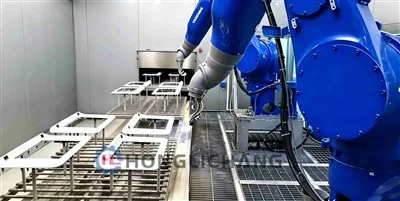
During spray painting, outside air is filtered through a primary filter and then delivered to the roof by a fan. After a second filtration and purification by a top filter, it enters the booth. The air inside the booth flows downwards at a speed of ≥0.3 m/s, preventing paint mist particles from lingering in the air and allowing them to pass directly through the bottom filter before being exhausted outside through the outlet. This continuous circulation ensures that the air cleanliness inside the booth reaches over 98% during spray painting, and the supplied air has a certain pressure to prevent dust from seeping into the spray booth and contaminating the workpiece surface, thus maximizing the quality of the paint job.
During baking, the damper is adjusted to the baking position, and hot air circulates, rapidly raising the temperature inside the baking booth to the predetermined drying temperature (≤80℃). The fan initially filters fresh outside air, which then exchanges heat with the heat exchanger before being delivered to the air chamber at the top of the baking booth. After a second filtration and purification, the hot air, through the internal circulation of the damper, is mostly reheated and reused, except for a small amount of fresh air, causing the temperature inside the baking booth to gradually increase. When the temperature reaches the set temperature, the burner automatically stops; when the temperature drops to the set temperature, the fan and burner automatically turn on again to maintain a relatively constant temperature inside the paint booth. Finally, when the paint baking time reaches the set time, the paint booth automatically shuts down, and the paint baking process is complete.